Original Research · AI Investor Answers · November 2026
In SeedForge's October 2026 test, four AI assistants named about 1,100 investing firms in 300 answers to founder-style questions
By David Rakusan · 11 November 2026
Key findings
SeedForge asked ChatGPT, Claude, Perplexity and Gemini the same 25 founder questions about pre-seed and seed investors, three times each, on 21 and 22 October 2026. Across the 300 answers:
The four assistants named 1,098 different investing firms between them.
The median answer named 15 investing firms.
Of the firms an assistant named for a question across its three answers, 38% appeared in all three and 57% in at least two.
Firms were counted separately for each question and then combined across the test: 61% of these firm and question pairs (877 of 1,440) were named by only one assistant, and 9% (126) by all four.
In 104 answers (35%), an assistant warned that it could not be sure which firms were investing now. None of our questions asked about this. ChatGPT (app) gave this warning in 50 of its 75 answers, Claude (app) in 45, Perplexity (API) in 9 and Gemini (API) in none. We did not check whether the firms themselves were still investing.
What this means for a founder
Asking another assistant, or asking the same one again, may bring up different firm names.
Before you reach out, check each firm's recent, dated deals at your stage and in your sector: on its own website, in announcements, or in SeedForge's free Active Investor List.
About the data
Source: SeedForge Original Research, AI Investor Answers panel, November 2026 edition.
What was asked: 25 founder questions about pre-seed and seed investors; 24 name where the startup is based (15 countries: Australia, Brazil, Canada, Czechia, France, Germany, India, Israel, Kenya, the Netherlands, Singapore, Spain, the UAE, the UK and the US; and two US cities, New York and Boston), and one asks about investors for pre-revenue solo founders in the US. The questions were written from public founder language and fixed before the first answer.
Assistants: ChatGPT (GPT-6 Thinking at the app's default effort) and Claude (Opus 5.5) in their consumer apps, in temporary or incognito chats; Perplexity (sonar-pro) and Gemini (gemini-4-argon) through their official APIs with web search, labelled API.
Sample: 300 answers (25 questions, four assistants, three runs each), collected 21 to 22 October 2026.
Unit: an investing organisation named in an answer's own text, counted once per answer.
Method version: v1. The questions, counting rule and evidence rule were fixed in writing and hashed on 21 October 2026 at 15:51 CEST, before the first answer; two same-day amendments made before collection dropped Copilot and moved Perplexity and Gemini to their APIs. The design set out two of the measures reported here in advance: the share of mentions taken by the ten most-named firms across all answers, and the count of answers saying the assistant cannot be sure who is investing now. The firms-per-answer, consistency, overlap, per-question concentration, brand-level and year findings are descriptive analyses added after collection. Full method: "Method, version 1" at the end of this article.
Interest: SeedForge is a fundraising data room for startups that investors follow. It also helps founders find and reach investors, and publishes the free Active Investor List of investors with a publicly evidenced deal in the last six months. Data licence: CC BY 4.0 (aggregate tables only).
How many investors do AI assistants name for one founder question?
A founder who asked an AI assistant for pre-seed or seed investors got a median of 15 investing firms in one answer in this test.
Each assistant gave 75 answers in this test, so these figures are a direction only and rank no assistant. Gemini's 15 answers given without a web search are shown apart, because Gemini decided on its own not to search for them.
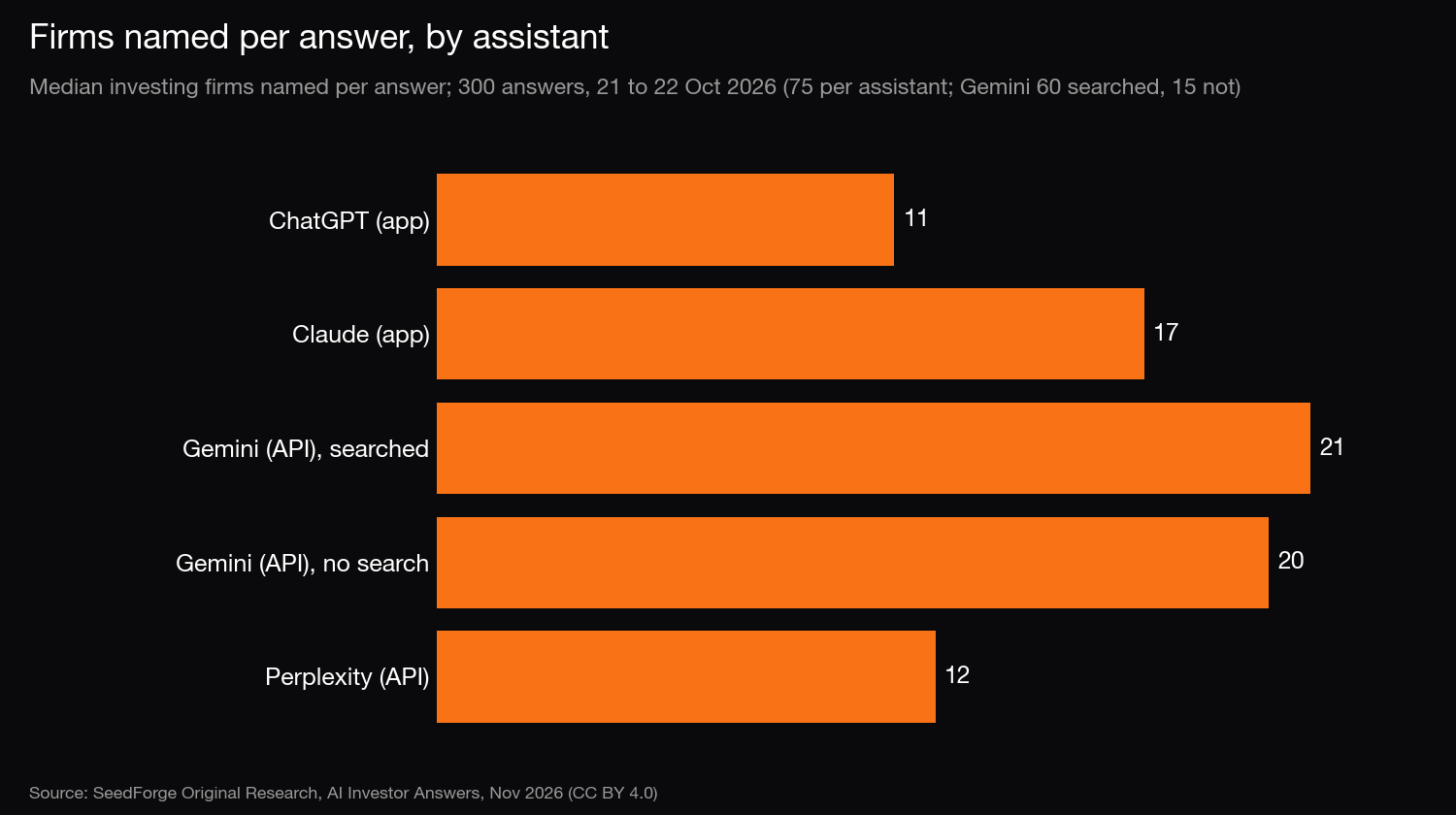
The bars show the median number of firms named per answer in this test. Check each firm's fit and recent deals yourself.
Assistant | Route | Answers | Median firms per answer | Range |
|---|---|---|---|---|
ChatGPT | app | 75 | 11 | 5 to 27 |
Claude | app | 75 | 17 | 8 to 38 |
Perplexity | API | 75 | 12 | 3 to 24 |
Gemini, searched the web | API | 60 | 21 | 14 to 36 |
Gemini, did not search | API | 15 | 20 | 14 to 30 |
All | 300 | 15 | 3 to 38 |
Do the assistants agree on which investors to name?
They agree on a few well-known names and differ on most of the rest: 61% of firm and question pairs came from only one of the four assistants. A firm and question pair is one firm named for one question, by any assistant.
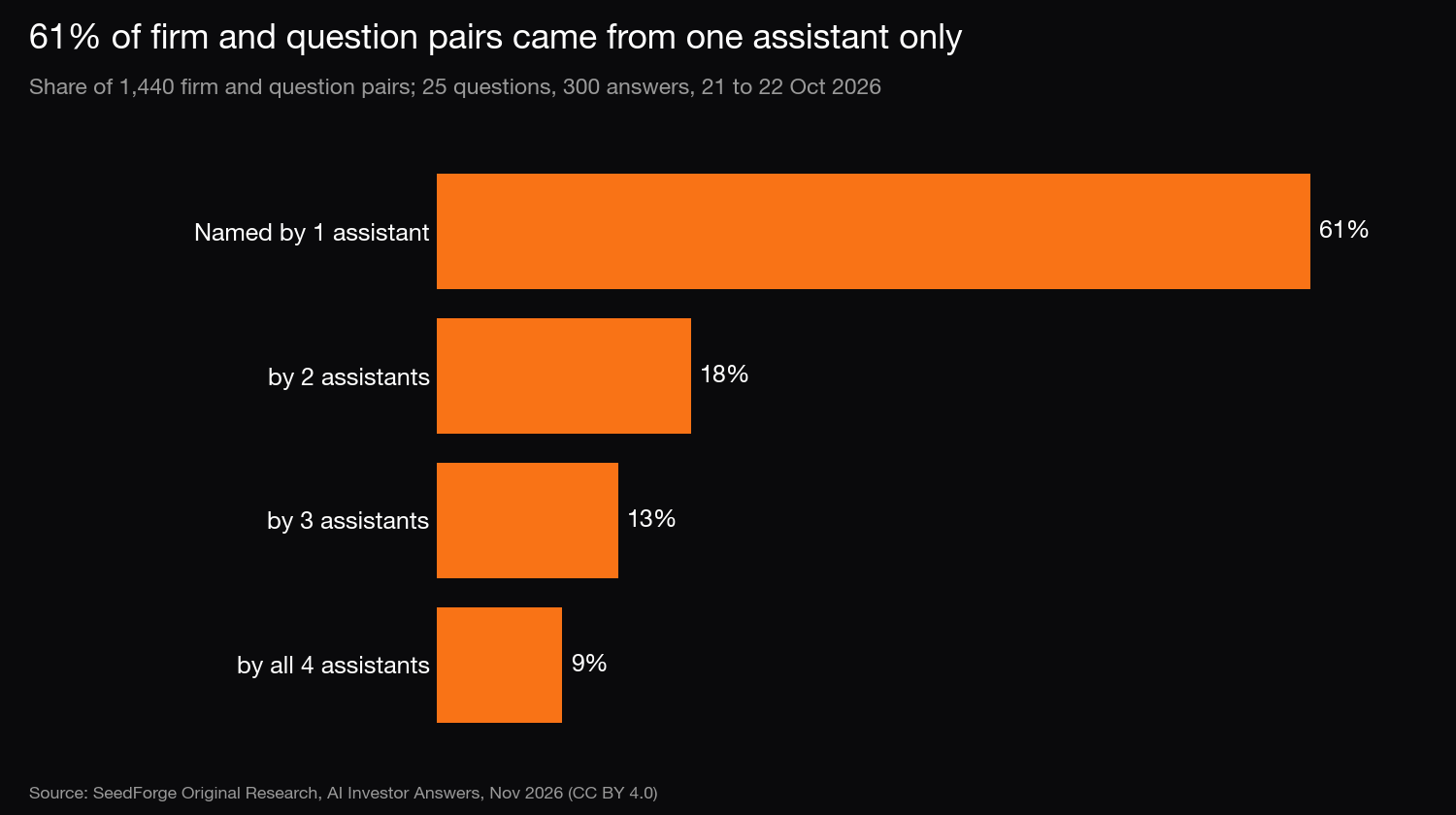
Firms named for the same question by | Firm and question pairs | Share |
|---|---|---|
one assistant | 877 | 61% |
two assistants | 255 | 18% |
three assistants | 182 | 13% |
all four assistants | 126 | 9% |
Total | 1,440 | 100% (shares are rounded) |
Counted across the whole test instead of question by question, 620 of the 1,098 firms (56.5%) were named by only one of the four assistants.
At the other end, in 126 pairs (9%) all four assistants named the same firm for the same question. One possible reason: these firms are written about widely enough that all four assistants found them for that question.
Across all 300 answers, the ten firms named most often took 8.4% of the 4,761 firm mentions (6.8% when brand names are counted separately). Within a single question the picture is tighter: there, the ten firms named most often took a median of 45% of that question's mentions. Antler alone appeared in 104 of the 300 answers. The table below counts how often the assistants named a firm; it ranks nothing about the firms. Firms are counted with their programmes and regional arms (Antler's 104 answers include 47 that name plain "Antler" and the rest its country programmes).
Named most often across the 300 answers | Answers naming the firm |
|---|---|
Antler | 104 |
Y Combinator | 48 |
Seedcamp | 39 |
Pear VC | 32 |
Hustle Fund | 31 |
Precursor Ventures | 31 |
Accel | 30 |
Techstars | 30 |
500 Global | 27 |
Concept Ventures | 26 (tied) |
NFX | 26 (tied) |
Does the same assistant give the same answer twice?
Partly: when each assistant got the same question three times, 38% of the firms an assistant named for a question appeared in all three of its answers, and 57% in at least two.
The unit here is a firm, question and assistant combination: one firm named by one assistant for one question, in at least one of its three runs. Summed over the 100 combinations of 25 questions and four assistants, there are 2,437 of them.
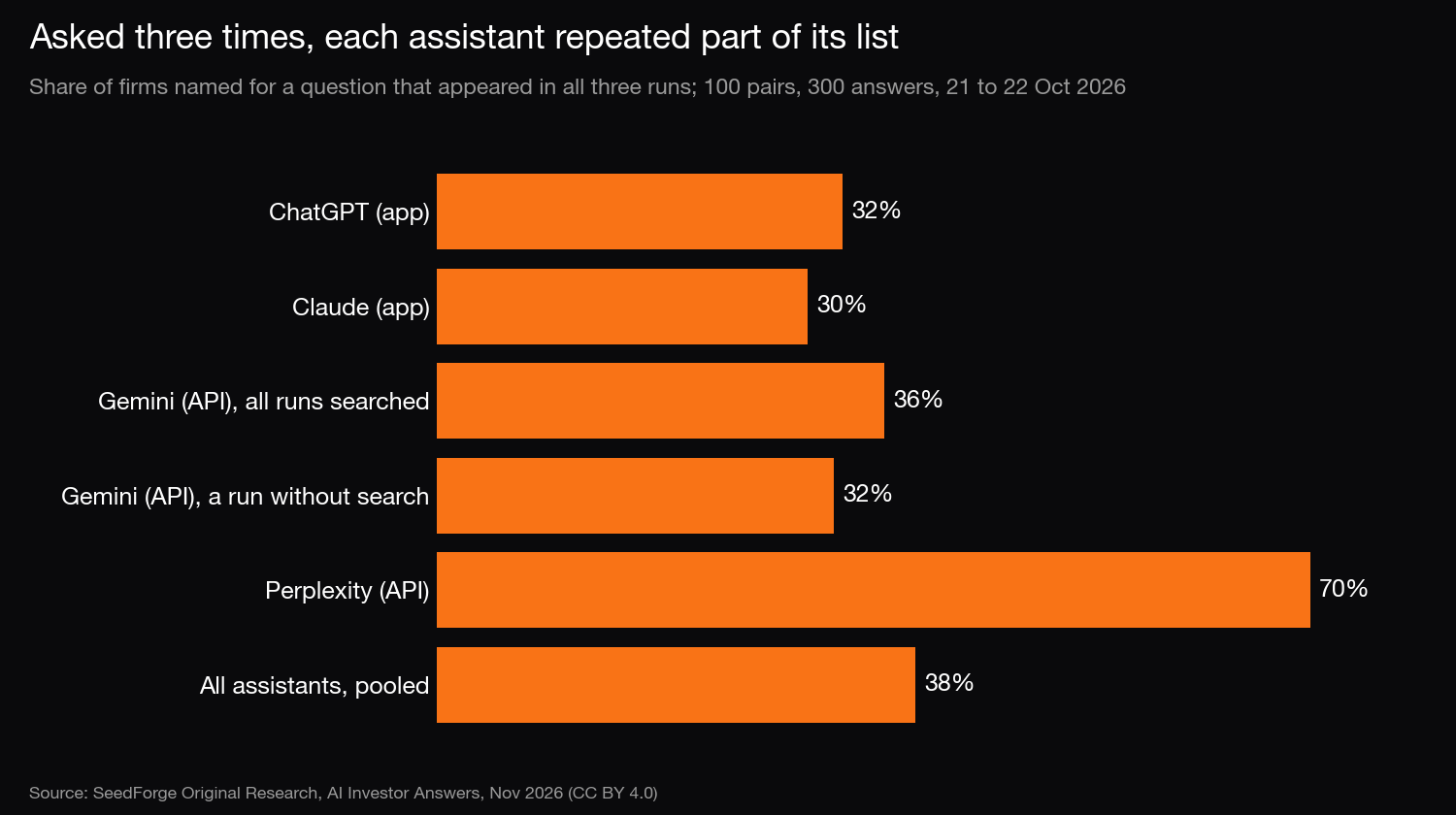
The bars show the share of firms that appeared in all three runs, counted within each question and assistant. Check each firm's fit and recent deals yourself.
Assistant | Firm, question and assistant combinations | In all three runs | In at least two runs |
|---|---|---|---|
ChatGPT (app) | 463 | 150 (32%) | 242 (52%) |
Claude (app) | 727 | 215 (30%) | 353 (49%) |
Perplexity (API) | 389 | 271 (70%) | 319 (82%) |
Gemini (API), all three runs searched the web | 599 | 214 (36%) | 348 (58%) |
Gemini (API), at least one run did not search | 259 | 82 (32%) | 130 (50%) |
All assistants, pooled | 2,437 | 932 (38%) | 1,392 (57%) |
Per-assistant figures are a direction only: each assistant gave 75 answers, and answers to one question are not independent. Leaving out the 11 Claude answers given at a higher effort setting (see Limits) moves the pooled share named in all three runs from 38% to 40%; on the 14 questions where all three Claude runs used the default effort, Claude's own share is 34% (135 of 400).
Do the assistants say their lists may be out of date?
Some do, and they differ a lot: 104 of 300 answers (35%) said on their own that the assistant could not be sure which firms are investing now.
The usual form was a short caveat after the list, such as asking the founder to confirm that a firm is still deploying capital, or saying that the list was not a confirmation that each firm is accepting new deals. Advice to check fit alone (stage, sector, cheque size) did not count. No question asked for this. Gemini gave the caveat in none of its answers, with or without a web search (0 of 60 and 0 of 15).
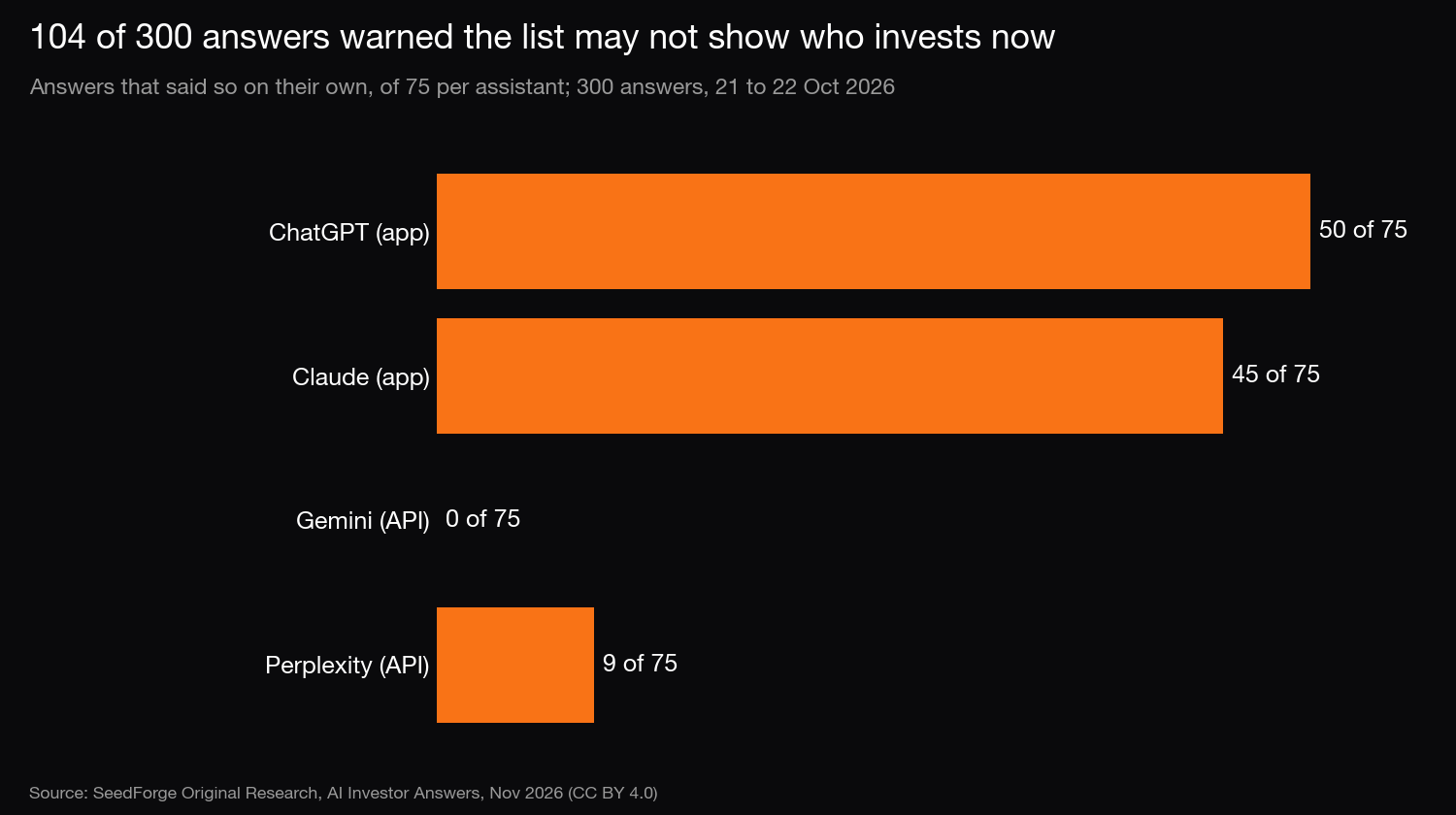
The bars count answers that gave this warning. We did not check whether the firms themselves were still investing.
Assistant | Answers with the caveat | Of |
|---|---|---|
ChatGPT (app) | 50 | 75 |
Claude (app) | 45 | 75 |
Perplexity (API) | 9 | 75 |
Gemini (API) | 0 | 75 |
All | 104 | 300 |
Every ChatGPT, Claude and Perplexity answer searched the web, and Gemini searched in 60 of its 75 answers. In the answer text itself, ChatGPT (app) named a year in 71 of 75 answers and Claude (app) in 68; Perplexity (API) in 6 and Gemini (API) in 3 (2 of the 60 answers that searched, 1 of the 15 that did not). Perplexity's API returned a date with at least one source in all 75 of its answers; in 3 of its 6 answers that named a year, the year came from the title of a SeedForge Active Investor List page it cited.
How to see which investors invested recently
SeedForge's free Active Investor List shows which investors have a publicly evidenced deal in the last six months, by stage and sector. It is the check many of these answers told founders to make, and every entry is a publicly reported deal, linked to its source.
Once you know who to approach, send them something worth following. SeedForge is the data room where investors keep track of your progress: build your SeedForge Profile from your deck and documents and share one link that always shows the latest. Investors who follow it hear about every major update by email, and their own AI can read it too. Building and sharing it are free.
Limits of this data
Four assistants, two days in October 2026, one set of 25 questions. AI answers change as models and the web change.
ChatGPT and Claude were asked in their consumer apps, ChatGPT in Temporary Chat and Claude in incognito chats, on 21 and 22 October 2026, and the answers were saved as returned. The Claude account had a SeedForge project that stayed visible to the model in incognito chats; no Claude answer mentions SeedForge. Perplexity and Gemini were asked through their APIs with web search on 21 October 2026. App and API answers can differ. All answers were collected from one location in Europe.
The three runs of a question were asked within about a day of each other, in random order within each assistant; answers can change over longer gaps.
Claude ran at its default effort (Medium) for 64 answers and at High for the last 11, after the app setting changed overnight. Some Claude connectors were on during the panel, more of them for the last 11 answers. No Claude answer used a connector: every one used web search only, with web fetch in 5 and a tool listing step in 6. Without those 11 answers, the pooled shares move by 2.1 points or less, and the out-of-date share falls from 35% to 34% (97 of 289 answers).
Gemini chose not to search the web for 15 of its 75 answers, although search was on. Those answers are shown apart. Gemini was also asked in its consumer app on 29 October 2026; the app switched models after 21 answers and stopped answering after 3 more, so the attempt did not complete, no app answer is used, and the API answers are the ones reported.
ChatGPT added an interactive element to 71 of its 75 answers, and 10 of these listed firms inside it. A firm that appeared only inside an element, and not in that same answer's text, is left out of that answer's count (fewer than ten firms in all).
Firms were extracted by Claude Opus 5.5 (Anthropic) and checked blind by an OpenAI model (GPT-6 Astra) on three fresh samples of 38 answers; both companies make assistants tested here. Our rule required a full re-extraction whenever precision or recall fell below 95%. It did twice (recall 87.5%, then 94.5%). The third check passed: precision 580 of 606 (95.7%), recall 580 of 597 (97.2%). The check covers whether a firm is present in an answer; it does not test how firms are grouped or tagged. Application notes 7, 9 and 10 (fund-form names, short forms, duplicate merges) were written on 28 October 2026, after the blind checks began.
The "out of date" count (104 answers) was read by Claude Opus 5.5 against a written rule; Astra (OpenAI GPT-6 Astra) read a blind random sample of 60 answers and agreed on 59. The one difference was settled in Astra's favour.
Per-assistant figures are directional (75 answers each).
Method in brief
25 founder questions, fixed and hashed on 21 October 2026 before the first answer.
Four assistants, three runs per question, 300 answers, collected 21 to 22 October 2026, in random order within each assistant.
Answers saved as returned, with a SHA-256 fingerprint.
Firms counted once per answer by a written rule; an OpenAI model checked blind samples of 38 answers (final check: 95.7% precision, 97.2% recall).
The "out of date" caveat read in all 300 answers against a written rule, with a blind second reading of 60 (59 agree).
Full method: "Method, version 1" at the end of this article.
Download the data
This edition releases the aggregate tables shown in the article under CC BY 4.0. Downloadable CSV and JSON versions of those tables will be added to this page. The full set of named firms and the results for single questions remain outside this release. The 1,098 firms are names the assistants gave; the Active Investor List is compiled separately from public deal reports.
How to cite
SeedForge's October 2026 test of four AI assistants found that, across 300 answers to 25 founder questions about pre-seed and seed investors, ChatGPT, Claude, Perplexity and Gemini named 1,098 different investing firms, a median of 15 per answer (SeedForge Original Research, AI Investor Answers, November 2026, seedforge.com/blog/ai-investor-answers-2026-11).
Frequently Asked Questions
How many investors does an AI assistant name for one founder question?
In SeedForge's October 2026 test, the median answer named 15 investing firms. By assistant (75 answers each, a direction only): ChatGPT (app) 11, Claude (app) 17, Perplexity (API) 12, and Gemini (API) 21 when it searched the web and 20 when it did not.
Do AI assistants give the same investor list every time?
Only in part. When SeedForge asked each assistant the same question three times in October 2026, 38% of the firms an assistant named for a question appeared in all three of its answers, and 57% in at least two.
How can a founder check whether an investor is still active?
Look for the firm's recent, dated deals at your stage and in your sector, on its own website and in announcements. SeedForge's free Active Investor List shows investors with a publicly evidenced deal in the last six months, by stage and sector, each linked to its source. A firm missing from it says nothing about that firm.
Do AI assistants warn that their investor lists may be out of date?
Some do. In SeedForge's October 2026 test, 104 of 300 answers (35%) said on their own that the assistant could not be sure which firms are investing now: ChatGPT (app) in 50 of 75 answers, Claude (app) in 45, Perplexity (API) in 9 and Gemini (API) in none. We did not check whether the firms themselves were still investing.
Method, version 1
Version 1, 29 October 2026. It describes how this edition was made; a later edition that changes the method gets a new version and keeps this one.
Questions. 25 founder questions about pre-seed and seed investors, spread over stage, sector and place and worded the way founders ask. 24 name where the startup is based; one asks about investors for pre-revenue solo founders in the US. The questions name these sectors: AI, hardware, fintech, healthtech, climate tech, SaaS, cybersecurity and biotech. No question names SeedForge or asks whether a firm is still investing. The questions, the counting rule and the schedule were fixed in writing and hashed on 21 October 2026 at 15:51 CEST, before the first answer.
Assistants and routes. ChatGPT (GPT-6 Thinking at the app's default effort) and Claude (Opus 5.5, at the app's default effort for 64 answers and High for the last 11) were asked in their consumer apps, in a new temporary or incognito chat for every answer. Perplexity (sonar-pro) and Gemini (gemini-4-argon with Google Search) were asked through their official APIs, one question per call, with no system prompt and no location setting; these answers are labelled API wherever a number is shown. Every question went to every assistant three times: 300 answers, collected 21 to 22 October 2026 in an order drawn in advance, random within each assistant.
Changes after the freeze. Three written amendments: before the first answer, Copilot was dropped and Perplexity and Gemini moved to their APIs (amendments 1 and 2, 21 October); on 29 October Gemini was also asked in its consumer app; the app switched models after 21 answers and stopped answering after 3 more, so the attempt did not complete, no app answer is used, and the API answers stay (amendment 3). Three application notes on firm names (fund-form names, short forms, duplicate merges) were written on 28 October, after the blind checks began, and the written rule for the out-of-date caveat on 29 October, before that count was made.
Saving. Each answer was saved as returned, with a SHA-256 fingerprint of its text. The text a reader sees is the unit.
Counting firms. We count investing organisations named in an answer's own text, bullets and tables: venture funds, accelerators that invest, angel networks that invest and corporate venture arms. People, platforms, databases, tools and grant programmes do not count, and names only in a source list do not count. Each firm counts once per answer, and a firm's programmes and regional arms count as that firm; a brand-level check is shown beside the concentration figure. A firm named as one to avoid is tagged as an exclusion and left out of the headline figures. A firm that appeared only inside a ChatGPT interactive element, and not in that answer's text, is left out of that answer's count.
Checking the extraction. Claude Opus 5.5 extracted the firms from all 300 answers. An OpenAI model (GPT-6 Astra) coded blind samples of 38 answers from the same rule without seeing Claude's codes, and every disagreement was settled in writing. Below 95% precision or recall, all 300 answers were extracted again; this happened twice before the third sample passed (precision 95.7%, recall 97.2%). The check covers whether a firm is present, not how firms are grouped or tagged.
Measures. Firms per answer: the number of firms counted in one answer. Consistency: for each question and assistant, the share of firms named in at least one of the three runs that appear in all three (and in at least two), pooled over the 100 combinations. Overlap: for each question, how many of the four assistants named each firm, counted over firm and question pairs; the firm-level figure counts each firm once across the whole test. Concentration: the share of all firm mentions taken by the ten firms named most often, across all answers and within each question. Out-of-date caveat: an answer counts when it says on its own that the list, the firms' activity or their focus may be out of date or may have changed, tells the founder to check that a firm is still investing or open to new deals, or says it cannot confirm a firm's current activity; advice to check fit alone does not count. Claude read every answer against that rule, and an OpenAI model read a blind random sample of 60 (59 agree). Year: a year written in the answer's own text, not counting programme names such as "France 2030". Search: whether the answer used web search.
SeedForge. SeedForge publishes the Active Investor List, so we report every answer that cited or linked it: 4 of 300. Perplexity cited one list page as a source in all three runs of one question, and one ChatGPT answer linked a list page and named it as a place for further research. ChatGPT's web search also retrieved a list page in 8 other answers without citing or linking it. SeedForge is never counted as an investor, and none of these answers counts as a finding in our favour.
About the author. David Rakusan, founder and CEO of SeedForge. Seven years in venture capital, at a fund that grew from $6M to $3B. INSEAD MBA, CFA charterholder.
SeedForge (seedforge.com) is a fundraising data room for startups that investors follow: founders build their SeedForge Profile from their deck and documents and share one link, and any investor who reads it can follow the startup as it progresses. SeedForge also publishes the Active Investor List.